Incubators and accelerators play a key role in the entrepreneurial ecosystem. They select promising startups, support them over several months, connect them with investors and experts, and help them accelerate their growth.
Yet many still rely on tools built for other purposes: spreadsheets to track startups, emails to communicate, Google Drive to share documents. This sprawl creates friction, blind spots and a degraded experience for everyone — startups as well as programme teams.
The state of play in 2026
From the feedback we collect regularly from incubator managers, here are the most frequently cited problems:
Application management is chaotic. Submissions arrive by email, via web forms, sometimes on paper. Each jury member evaluates them differently. It is hard to compare candidates and justify selection decisions.
Cohort tracking is incomplete. Once startups are selected, follow-up usually relies on regular meetings and informal exchanges. There is no system to record milestones, blockers and useful introductions made.
Communication is inefficient. Sending an update to all startups in the current cohort — and only to them — requires maintaining lists, copy-pasting emails and managing replies manually.
The mentor network is under-leveraged. Most incubators have a well-stocked roster of mentors. But matching them with startups in need remains artisanal: a phone call, an email, sometimes a LinkedIn message.
Reporting to funders is laborious. Public grants and private partnerships require regular reports. Building them from scattered spreadsheets takes a huge amount of time.
What coordinated digitalisation changes
Digitalising an incubator is not about replacing people with technology. It is about using tools to eliminate administrative friction, so that teams can focus on what truly creates value: supporting startups.
A structured application process
An online application form, plugged into a management platform, completely transforms the experience. Each application is instantly accessible to all jury members. Standardised evaluation criteria make it possible to compare files objectively. The history of decisions is preserved.
For startups, the experience is also better: they can track the progress of their application, receive automatic notifications and complete their submission progressively.
Real-time cohort tracking
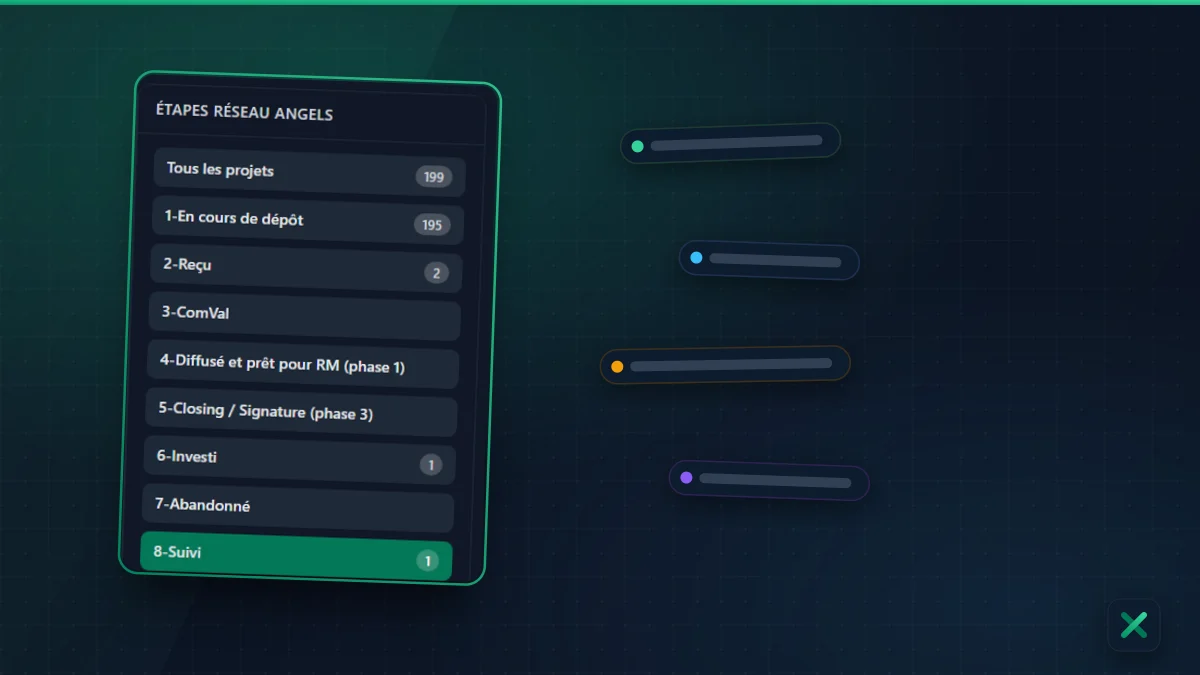
Picture a dashboard where you see at a glance the status of every startup in your programme: milestones hit, blockers in progress, upcoming meetings, introductions made.
This dashboard is fed continuously by the startups themselves (updating their profile) and by managers (notes from regular check-ins). Information is centralised, accessible and traceable.
Targeted and automated communication
Cohort-based communication becomes trivial. You send a message to every startup in the current intake with one click. You can filter: only startups in pitch phase, only those looking for investors, only those in the greentech sector.
Event invitations, meeting reminders, programme update notifications: everything can be automated, with personalisation by startup name.
Activating the mentor network
With a structured mentor directory, teams can filter by sector, expertise, availability and type of intervention. Matchmaking is documented: date, startup, topic discussed, outcome.
This system makes it possible to measure mentor engagement, identify those who deliver the most value and recognise them accordingly. It also makes recruiting new mentors easier: they can see the value of the network before committing.
Simplified reporting
When all data is centralised — applications, selections, milestones, interventions, funding raised — reporting becomes near-automatic. Statistics are generated in seconds: number of startups supported, two-year survival rate, amounts raised, jobs created.
A fast return on investment
Digitalising an incubator is an investment. But the return is generally quick, for several reasons.
Time saved is immediate. Programme teams often spend 30 to 40% of their time on administrative tasks (email, data collation, meeting notes). Digitalisation cuts this time in half within a few weeks.
The quality of support improves. With less time spent on admin, teams can devote more time to direct support of the startups.
The reputation of the incubator improves. Startups that experience a professional, structured and smooth journey talk about it. The volume of high-quality applications goes up.
Reporting to funders becomes a competitive advantage. An incubator able to produce precise and up-to-date statistics on its impact is more credible when funding renewals come up.
Where to start
Digitalisation is not a project to do all at once. Here is the progressive path we recommend.
Step 1 (months 1–2): Centralise applications. Set up an online form and an interface to evaluate them collectively. This is the workstream with the fastest return on investment.
Step 2 (months 3–4): Structure cohort tracking. Create startup profiles and define your programme milestones. Start populating the data in real time.
Step 3 (months 5–6): Automate communication. Configure automatic notifications, follow-up emails and event invitations.
Step 4 (month 7+): Activate reporting. Once the data is structured, reporting becomes almost automatic.
The mistake to avoid
The biggest mistake is to choose a generalist tool — a CRM, a project management tool, a no-code database — and adapt it to running an incubator.
Those tools are not designed for your specific needs. You will spend weeks configuring them, only to land on an imperfect result. And within a year you will be blocked by limitations you didn’t anticipate.
Prefer a tool designed specifically for managing investment and support networks. It will save you time from day one.
Conclusion
Digitalising an incubator is now a necessity, not an option. Startups are technology companies: they have high expectations regarding digital experience. Funders demand transparency and traceability. Programme teams need efficient tools to stay competitive.
The incubators that digitalise their management in 2026 are taking a lasting lead over those that wait.
DealFlux is the management platform designed for incubators, accelerators and investment networks. Discover how it can fit your programme or request a demo.