A promising startup is never supported by a single organisation. It goes through an incubator, catches the eye of an early-stage fund, is presented to an investor club, sometimes reviewed by a Business Angel network. That is the normal workings of a healthy investment ecosystem: organisations pass projects along, co-invest, complement one another.
Yet these organisations digitised in silos: each chose its own tool, configured its own process, built its own base of files. Each organisation, taken in isolation, is better organised than before. But the ecosystem is not — and it is the founder who pays the price.
The story of AgriNova, silo edition
Take a fictional example: AgriNova, an AgTech startup developing irrigation sensors for vineyards.
AgriNova is selected by a regional incubator. Its founder fills in the application form: team, market, traction, forecasts. She uploads her pitch deck, her articles of association, her cap table. For eight months, she feeds the incubator’s tracking tool: milestones, progress reports, updates to the file.
Then comes the time to raise. The incubator recommends her to an early-stage fund. The fund has its own tool: the founder fills in a new form, re-uploads the same documents, rewords the same answers in a slightly different format. The eight months of support history? It fits in a three-paragraph recommendation email.
A few weeks later, the fund suggests widening the round to an investor club. A third tool, a third form, a third upload of the same documents — some of which have changed in the meantime, so that different versions of the forecasts are now circulating in three systems.
The verdict on this siloed digitalisation is paradoxical: every organisation has a fine tool, and the founder spends her evenings re-keying data. The organisations, for their part, are working from partial, out-of-sync information. Nobody cheated, nobody did a poor job: the architecture is to blame.
The same story, coordinated edition
Let’s replay AgriNova’s journey, this time assuming the incubator, the fund and the club work on a common platform — not with a common process, but on a platform that lets them share a single project.
At the outset, nothing changes for the incubator. It has its pipeline, its programme stages, its file tabs, its required fields. AgriNova applies, is selected, is supported. The file fills out over eight months.
When the raise comes, the incubator offers to share. With the founder’s explicit consent, the project is shared with the early-stage fund. Not a copy: a share. The founder and the incubator choose precisely what the fund will see — the presentation file, the up-to-date forecasts, the milestones reached — and what stays private, such as the internal support notes.
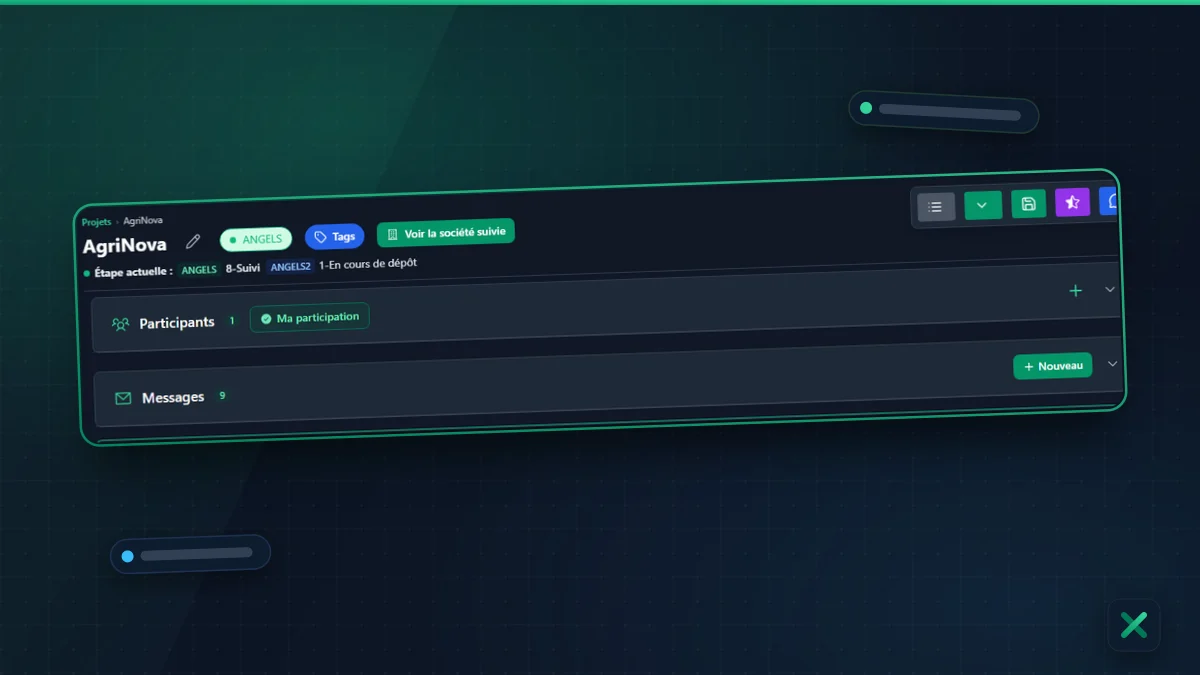
The fund sees AgriNova in its own pipeline. Not in the incubator’s: in its own, at the “Opportunity” stage, with its own tabs — some of which, like the due diligence tab, will only appear once the file reaches the corresponding stage. The fund requires fields the incubator never asked for? The founder fills those in — and only those. Everything that already exists is already there.
The investor club joins the round. A new share, a new scope: the club sees the presentation and the terms of the round, not the fund’s internal assessments. Its members discover the project in the club’s project space, with the club’s own formalities.
At no point has the founder re-entered a single piece of information. At no point has an organisation given up its way of working. And at no point has a document gone astray: every share has a scope, a recipient and consent.
What “coordinated” means — and doesn’t mean
The classic misunderstanding is to believe that working on a common platform imposes a common process. It is the opposite that gives the approach its value.
Each organisation keeps its own flow of stages. The incubator’s four-phase programme, the fund’s seven-stage investment process, the club’s presentation journey: each configures its own. The same project appears simultaneously at different stages in different pipelines — and that is as it should be, because those stages describe different relationships to the project.
Each organisation chooses its tabs, and when they appear. The “Programme tracking” tab exists only at the incubator. The “Due diligence” tab only appears at the fund from the analysis stage onwards. The file presents itself to each organisation in the form that matches its line of work.
Each organisation defines its required fields. What is essential for one is superfluous for another. The founder fills in the gap, never the whole thing.
Sharing is granular and consented. You don’t share “the project” wholesale: you share stages, documents, assessments, messages — element by element, with the founder’s agreement. Each organisation remains in control of what it exposes of its own work.
In short, the coordination is not about processes, which remain each organisation’s own, but about the data: a single source, multiple views.
Why everyone wins
The founder, first. Zero double entry: their file lives in one place and follows them throughout their journey. The time saved is time given back to the project itself.
The organisations, next. A shared file arrives complete, up to date and in context: eight months of support no longer boil down to a recommendation email. Due diligence starts sooner, co-investments are built on a common base of information, and the bridges between partner organisations become an organised flow rather than a succession of PDF hand-offs.
The investment ecosystem, finally. Projects circulate better between incubators, accelerators, early-stage funds, entrepreneurial clubs and Business Angel networks. The organisations that are good at passing projects along become sought-after partners — for founders and for other organisations alike.
Conclusion
The first wave of digitalisation equipped organisations one by one. It solved the internal problems — pipeline, files, assessments, communication — and that was necessary. But it left untouched, indeed made worse, the problem that sits between organisations: a project that changes hands starts again from zero.
Coordinated digitalisation tackles precisely that point: a single project, shared between several organisations, each seeing it in its own pipeline, with its own stages, tabs and requirements. The founder enters everything once; the organisations keep their habits; the sharing remains consented and controlled.
It is a change that looks discreet — no organisation upends how it works — and runs deep in its effects: the investment ecosystem finally starts to behave like an ecosystem.
DealFlux is the platform that lets different investment organisations — incubators, accelerators, early-stage funds, entrepreneurial clubs, Business Angel networks — share a single project, each in its own way of working. Discover who uses DealFlux or request a demo.